.png)
The Psychology Behind Procrastination


You know the task needs to be done.
It's important.
You've even blocked out time in your calendar to work on it.
But instead of getting started, you check your inbox one more time.
Reply to a few messages.
Reorganise your desktop.
Scroll through LinkedIn.
Tell yourself you'll begin after lunch.
Before you know it, the day is over, the task is still waiting.
Sound familiar?
You're not alone.
Procrastination affects students, professionals, executives, and business owners alike. In fact, many high achievers procrastinate on the work that matters most.
The surprising part is that procrastination usually isn't about poor time management.
It's about how our brains respond to discomfort.
Procrastination is the tendency to delay important tasks despite knowing there may be negative consequences. Psychologists believe it's often driven by emotional discomfort, fear of failure, perfectionism, decision fatigue, or feeling overwhelmed—not laziness or a lack of motivation.
Procrastination Isn't Laziness
People often use the words lazy and procrastinating interchangeably.
They're not the same.
Laziness is a lack of willingness to act.
Procrastination is delaying action, even when you genuinely want to complete the task.
Think about the last time you put off something important.
You probably weren't relaxing.
You were still busy.
You answered emails.
Attended meetings.
Organised files.
Completed smaller tasks.
Your brain chose activities that felt easier because they provided immediate satisfaction while avoiding something mentally uncomfortable.
Your Brain Prefers Immediate Rewards
Human brains are wired to seek immediate gratification.
Writing a business proposal, reviewing financial reports, or documenting processes may benefit you in the future, but they don't provide an instant reward.
Checking your phone does.
Crossing off five small tasks does.
Replying to a quick email does.
Psychologists call this present bias, our tendency to value immediate rewards more than future benefits.
That's why people often choose the easier task, even when they know it's not the most important one.
Why Business Owners Procrastinate
Business owners often assume they don't procrastinate because they're constantly busy.
But busyness can be a form of procrastination too.
Instead of tackling strategic work, they spend the day:
answering emails
approving invoices
responding to messages
fixing operational issues
attending unnecessary meetings
These tasks feel productive.
But they're often easier than making difficult decisions about growth, hiring, pricing, or long-term planning.
Sometimes procrastination isn't avoiding work.
It's avoiding the right work.
The Emotional Triggers Behind Procrastination

Procrastination is often emotional before it's practical.
Here are some of the most common triggers.
Fear of Failure
Starting a difficult project means risking mistakes.
Delaying it temporarily protects us from that uncomfortable feeling.
Ironically, the delay often creates even more stress.
Perfectionism
Many professionals postpone tasks because they want the outcome to be perfect.
But waiting for the perfect moment or the perfect idea usually means waiting too long.
Progress almost always beats perfection.
Feeling Overwhelmed
Large projects can feel intimidating.
When the brain doesn't know where to begin, it often chooses not to begin at all.
Breaking a project into smaller steps reduces that mental resistance.
Decision Fatigue
Every decision consumes mental energy.
By the end of the day, your brain naturally looks for easier choices.
That's why many important tasks keep getting pushed to "tomorrow."
Why Technology Makes Procrastination Easier
Modern workplaces are full of distractions.
A single notification can interrupt deep thinking.
Emails arrive every few minutes.
Messaging platforms demand instant replies.
Social media offers endless opportunities to escape uncomfortable work.
These distractions don't just consume time.
They also make it harder to return to focused work.
Every interruption forces the brain to reset.
The Cost of Procrastination in Business

Delaying important work doesn't just affect productivity.
It affects business performance.
Common consequences include:
missed opportunities
delayed decisions
slower growth
rushed projects
increased stress
reduced innovation
For healthcare providers, clinics, and growing SMEs, procrastination can also lead to:
delayed process improvements
inconsistent follow-ups
postponed hiring decisions
operational bottlenecks
Over time, these small delays can have a significant impact.
How to Break the Cycle
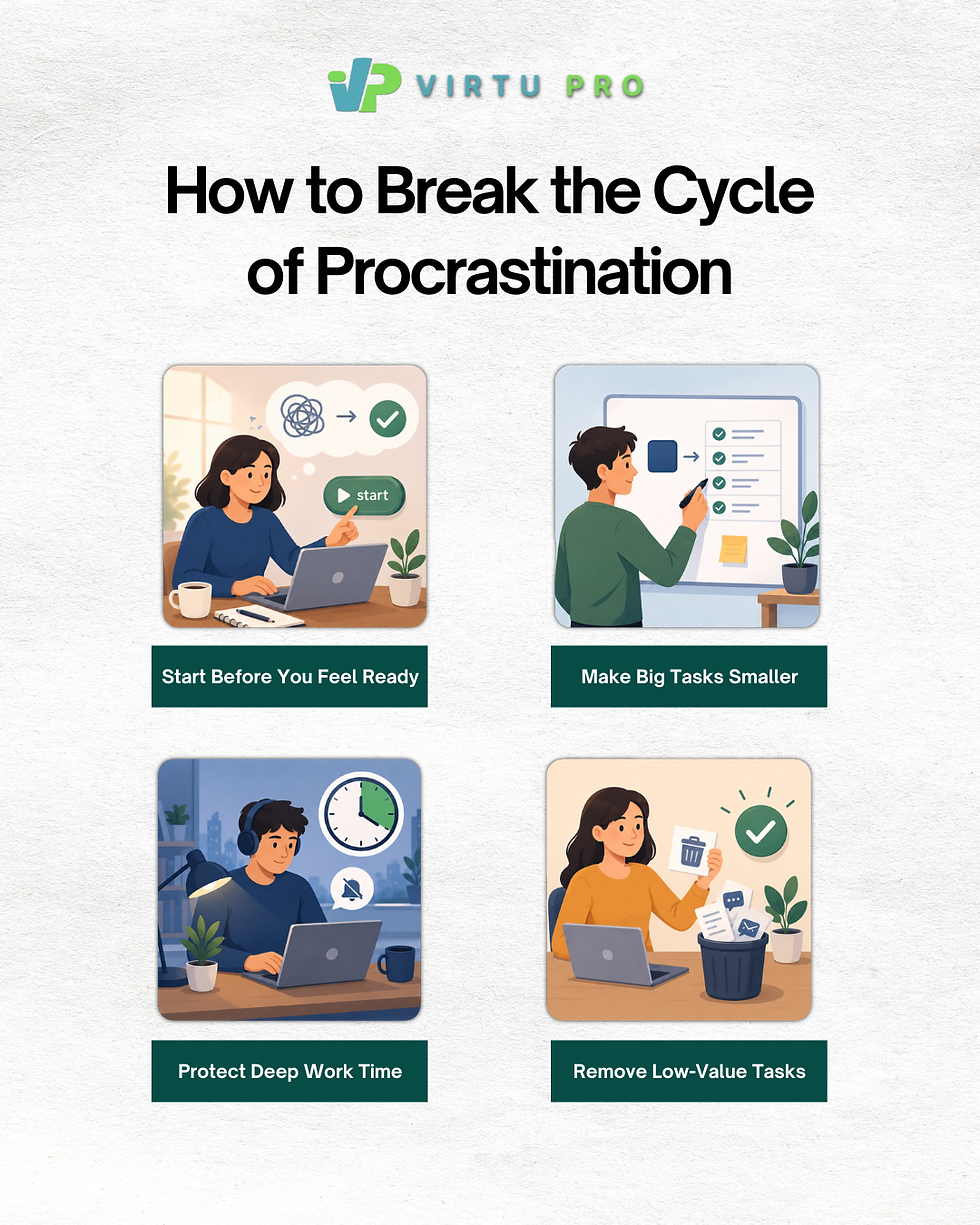
Understanding procrastination is helpful.
Changing behaviour is even better.
Here are a few practical strategies.
Start Before You Feel Ready
Motivation often comes after you begin.
Commit to working on a task for just ten minutes.
Starting is usually the hardest part.
Make Big Tasks Smaller
Instead of writing "Create marketing strategy," write:
research competitors
outline objectives
draft messaging
review plan
Smaller tasks feel more achievable.
Protect Deep Work Time
Block uninterrupted time for your most important work.
Turn off notifications.
Close unnecessary tabs.
Treat this time as seriously as you would an important meeting.
Remove Low-Value Tasks
One reason business owners procrastinate on strategic work is because they're overwhelmed by administrative responsibilities.
If repetitive tasks consume your day, there's little mental energy left for high-value thinking.
Delegating routine work such as inbox management, scheduling, customer follow-ups, or data entry, can create the space needed to focus on decisions that move the business forward.
Progress Beats Perfection
One of the biggest myths about successful people is that they always feel motivated.
They don't.
They simply build systems that help them act even when motivation is low.
Successful businesses don't rely on willpower alone.
They rely on:
routines
prioritisation
delegation
clear processes
supportive teams
These systems reduce the opportunities for procrastination to take over.
Conclusion
Procrastination isn't a character flaw.
It's a human response to uncertainty, pressure, and emotional discomfort.
The good news is that it can be managed.
By understanding the psychology behind procrastination, breaking work into manageable steps, reducing distractions, and creating better systems, professionals can spend less time avoiding important work and more time making meaningful progress.
For many Australian businesses, that also means recognising when administrative tasks are consuming too much mental energy. Providers like VirtuPro help businesses reduce that operational burden through trained virtual assistants who handle routine administrative work, allowing business owners and teams to focus on strategic priorities rather than constant busywork.
Because productivity isn't about doing more.
It's about making progress on what matters most.


7K Bet bônus foi a desculpa perfeita pra eu fuçar o site e entender onde eles colocam as promoções. Eu nem fiquei caçando valor de boas-vindas nem essas coisas, mas deu pra ver que existe mesmo uma área própria, com aquele título “nova área de prêmios e recompensas” aparecendo bem na estrutura. O que achei legal é que não parece tudo mastigado: algumas infos mais críticas (tipo detalhes completos do bônus) não ficam tão expostas de cara, então dá aquela sensação de “ok, preciso conferir na página oficial de promoções”. No uso normal, a navegação é bem de boa, com os blocos separados e fácil de bater o olho e achar o que quer. Essa seção de promoções fica bem…
https://thoitiethomnay.org/ Lúc đầu mình cũng hơi lăn tăn không biết có gì hay để mở ra coi nhanh không. Vào thử thì thấy trang hiển thị khá gọn, vừa mở là đập vào mắt ngay nhiệt độ hiện tại (mình thấy đang 30°C) kèm “cảm giác như” nên khỏi phải đoán hôm nay nóng mức nào, nhìn phát hiểu luôn; thêm cái hay là có ô chọn tỉnh/thành đặt ngay chỗ dễ thấy nên mình đổi qua lại giữa mấy nơi quan tâm rất nhanh, không phải kéo lên kéo xuống tìm. Mình thích kiểu cập nhật trong ngày, kiểu sáng coi một lần rồi trưa quay lại vẫn có số liệu mới chứ không đứng im. Nói chung dùng…
rr 88 mình vừa mở lên để xem họ sắp xếp trang thế nào và thông tin đặt ở đâu cho dễ đọc, kiểu lướt nhanh vài phút là biết có gọn gàng không. Giao diện nhìn thân thiện, các khối nội dung canh khá ngay hàng nên mắt mình bắt được thông tin nhanh. Chuyển mục cũng mượt, bấm qua lại không thấy bị khựng. Mình để ý họ có nhắc tới kho game hơn 1.000 thể loại, nhưng mình không đào sâu, chỉ xem cách họ trình bày thôi. Có một phần nói về nguồn gốc pháp lý được công khai khá rõ ràng, đọc qua thấy yên tâm hơn so với mấy trang giấu thông tin. Nói…
kèo nhà cái mình thấy mọi người bàn tán nhiều quá nên cũng bấm vô xem thử cho biết. Mình không đọc kỹ nội dung hay soi từng mục đâu, chủ yếu xem giao diện có dễ nhìn, dễ tìm thông tin không thôi. Vừa vào là thấy bố cục khá gọn, khoảng trắng vừa đủ nên nhìn không bị ngộp. Mấy phần thông tin được chia thành từng khối rõ ràng, lướt xuống vẫn theo kịp chứ không kiểu dồn chữ một cục. Mình cũng để ý thanh menu đặt ngay chỗ dễ thấy, bấm qua lại vài trang thấy mượt, không bị rối hay phải quay lại nhiều lần. Nói chung cảm giác như họ sắp xếp để…
Mình cũng hay đọc mấy bài phân tích cầu lô đề kiểu này để có thêm góc nhìn, chứ không bao giờ coi là chắc chắn. Hồi trước mình toàn đánh theo linh cảm, có bữa trúng bữa trật nên dễ chán, sau đó mới tự ghi lại những con hay thấy rồi thử xem có hay quay lại theo nhịp nào không. Đọc mục soi cầu xổ số miền bắc hôm nay mình thấy cách giải thích dựa trên thống kê và dấu hiệu lặp lại khá rõ ràng, ít nhất giúp mình có sườn để cân nhắc thay vì đoán đại. Dù vậy mình vẫn tự nhắc chỉ chơi vừa thôi cho vui, vì càng cố gỡ càng…